

When families ask us about an orthodontic consultation, what to expect is usually the first question. At your complimentary consultation with Amini Orthodontics, at our West Side office on Culebra Road or our North-East office on FM 78, you can expect four things. First, our team takes your records: a panoramic X-ray, a cephalometric (side view) X-ray, digital scans and photographs. Second, one of us examines your teeth, bone, bite and jaw relationships, and looks at airway and jaw joint (TMJ) factors when that is clinically appropriate. Third, you sit down with your orthodontist to review a customized treatment plan, your options (metal or ceramic braces, Invisalign, Angel Aligners or our in-house aligners) and an estimated timeline. Most of our cases finish in about 12 to 24 months. Fourth, our team explains your total treatment fee and payment options before you commit to anything. You can book your free consultation here.
Quick answer: One visit, full records, a real diagnosis, a written-out plan with a timeline, and a clear fee. You leave knowing what is going on with your teeth or your child’s teeth, even if the answer is “not yet.”
A consultation is a diagnosis, not a sales pitch
Parents often tell us they expected a quick look and a brochure. That is not how we run this appointment. We take the same diagnostic records at a free consultation that we would need to start treatment, because we do not think you can make a good decision about braces or aligners without seeing what is happening under the gums and in the jaws.
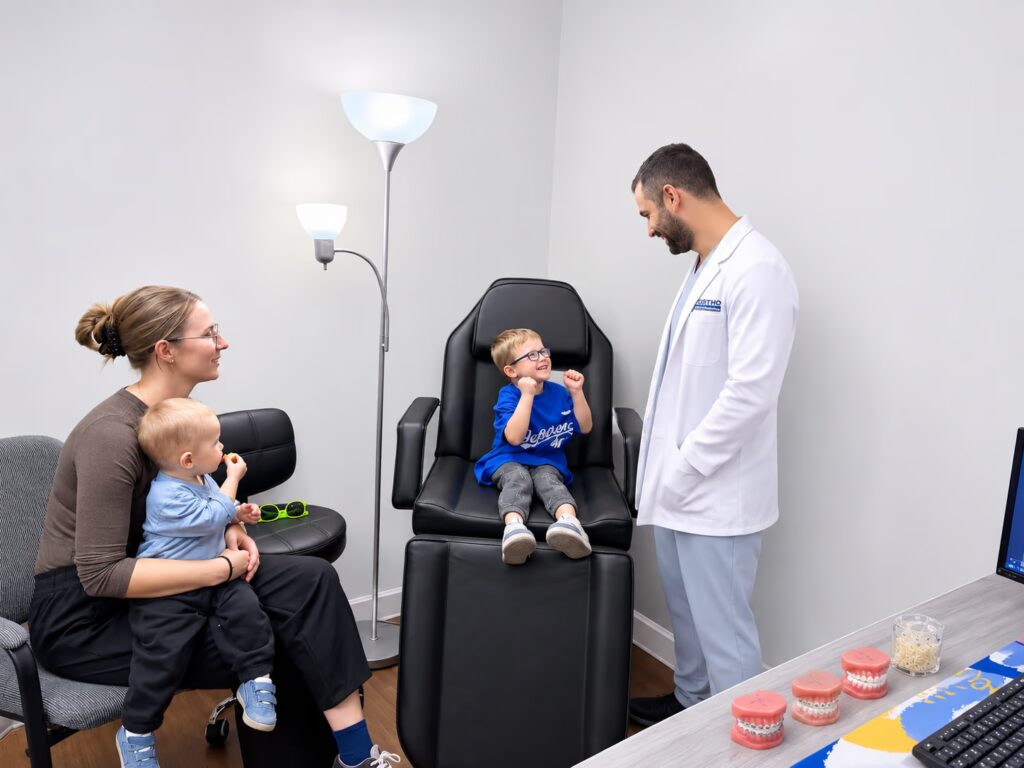
Dr. Scott Caradonna, DMD, an orthodontist at Smile Orthodontics in Leominster, MA, describes the visit this way: “A consultation is a great way to understand why you might benefit from treatment and what your options are. It also gives you a chance to learn about your overall oral health and meet your orthodontist in person. Since orthodontic treatment takes longer than most dental care, it’s important that you feel comfortable with your doctor and team.”
We agree with that last point. At our practice, the orthodontist you choose oversees your treatment from start to finish, and both of us remain available to give a second perspective when it helps. Dr. Amini and Dr. Mansouri see continuity as the point of a private, family-owned practice: your plan is reviewed by both board-certified orthodontists, while you keep seeing the same doctor at every visit. You can read more about how we work on our About Us page.
Before you arrive: a short checklist
You do not need to prepare much, but a few things make the visit more useful.
- Your insurance card. We are in network with several major dental plans. If you call our West Side office at (210) 350-1221 with your insurance information before the visit, our team can verify your coverage ahead of time.
- Your questions, written down. The American Association of Orthodontists (AAO) suggests bringing prepared questions so nothing gets forgotten. Common ones: Does my child need treatment now or later? Braces or aligners? How long will it take?
- Anything you have noticed at home. For children, this includes early or late loss of baby teeth, trouble chewing, mouth breathing, jaws that shift or click, and thumb sucking. These are signs the AAO lists for parents to watch for.
- Records from a previous orthodontist, if you are transferring. We accept transfer cases, and there is no consultation fee for them.
Step one: your records
Your consultation starts with records. This is the part most people do not expect at a free visit, and it is the part that makes the rest of the appointment worth your time.
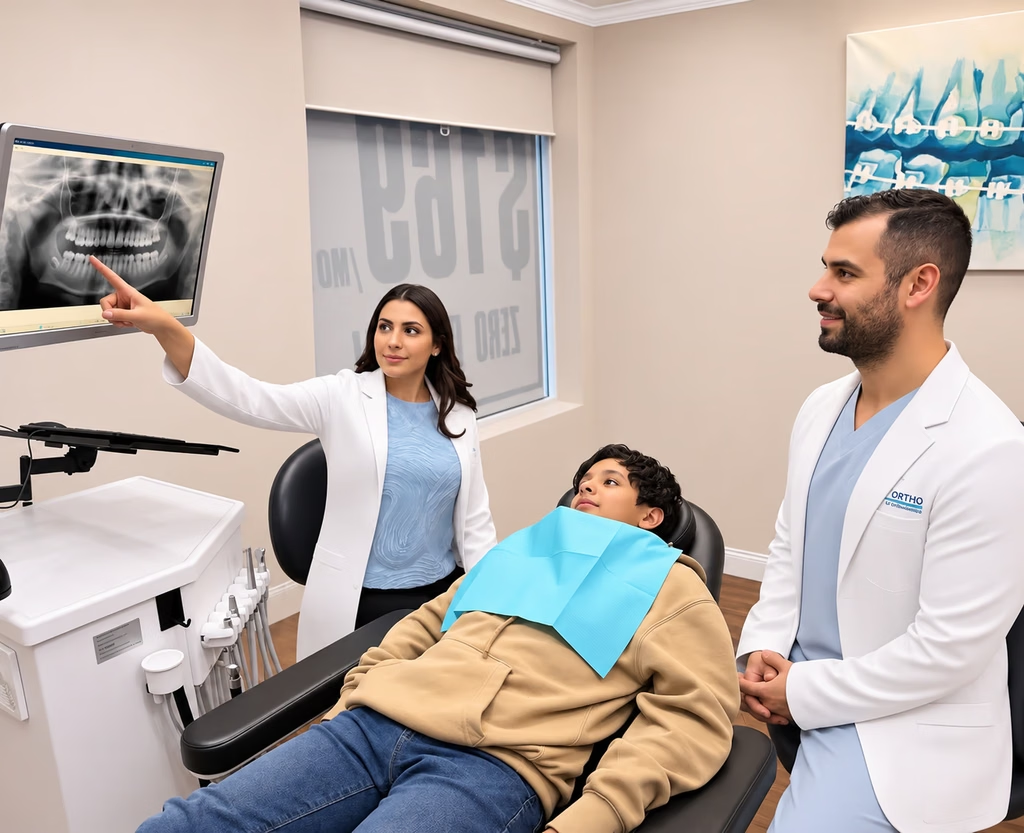
Panoramic X-ray. This single image shows all of the teeth, including the ones that have not come in yet, the roots and the surrounding bone. In children it tells us whether permanent teeth are developing on schedule and whether any are impacted (stuck). In adults it shows bone levels and existing dental work.
Cephalometric X-ray. This is a side view of the head. It lets us measure how the upper and lower jaws relate to each other and to the rest of the face. A bite problem can come from the teeth, the jaws or both, and this image is how we tell the difference.
Digital scans and photographs. We scan the teeth instead of using messy impression material, and we take photos of the face and smile. These help us evaluate crowding, how the teeth fit together and how the smile sits in the face.
The AAO notes that X-rays are necessary for an accurate orthodontic diagnosis and that modern X-ray machines emit significantly less radiation than older equipment. The exam itself should not cause any discomfort.
Step two: what we are looking at
Once your records are taken, your orthodontist examines your teeth, gums and bite in the chair and reviews the images. We are looking at more than whether teeth are crooked.
Teeth and bone. Is there enough bone to move teeth where they need to go? Are any teeth impacted, and if so, can they be guided into place?
Bite and jaws. How do the upper and lower teeth meet? Is a crossbite, open bite, deep bite or underbite coming from tooth position or from jaw size and position?
Growth. For children and teens, we consider how much growth is left and how it may affect the result.
Airway and jaw joints, when appropriate. Dr. Mansouri is board-certified in both orthodontics and dental sleep medicine. Her training at Tufts University included the airway and its relationship to obstructive sleep apnea, and her earlier background is in pediatric dentistry. When a patient’s history or symptoms suggest breathing or sleep may be affecting development, we consider those factors as part of the plan. Dr. Mansouri looks at the whole picture, including facial profile and jaw development, rather than tooth alignment alone. You can learn more on our airway orthodontics page.
Complex cases. Dr. Amini is the orthodontist on the Methodist cleft lip and palate craniofacial team. If your consultation shows a significant jaw discrepancy, cleft condition or multiple impacted teeth, we will explain what is involved and how we coordinate with surgeons and other specialists. Our goal is the least invasive approach that can give an appropriate result. Dr. Amini and Dr. Mansouri recommend surgery only when the jaw relationship cannot be corrected well with orthodontics alone. Details are on our surgical and cleft lip and palate orthodontics page.
Step three: sitting down with your plan
This is the conversation most families came for. Your orthodontist walks you through what the records show, what the problem is and what your options are.
Braces or aligners. Both can work well. Aligners are removable, so the result depends on consistent daily wear. Braces are fixed and do not rely on the same level of daily compliance, and for some movements or more complex cases, braces give more predictable control. Cases involving significant extraction mechanics, impacted teeth that need surgical exposure, or complex skeletal movements may do better with braces or a combination of appliances. Dr. Amini and Dr. Mansouri recommend the appliance that fits the movement the teeth need, rather than starting from a favorite product.
The choices within each option. We offer metal braces, ceramic braces for a more discreet look, and both conventional and self-ligating brackets. For aligners, we offer Invisalign, Angel Aligners and our in-house clear aligners. Your orthodontist will explain the differences that matter for your case. See our braces page and our Invisalign and clear aligners page for an overview.
Your timeline. Most of our cases are treated in about 12 to 24 months, depending on complexity. You will leave with an estimate based on your own records, not a general range.
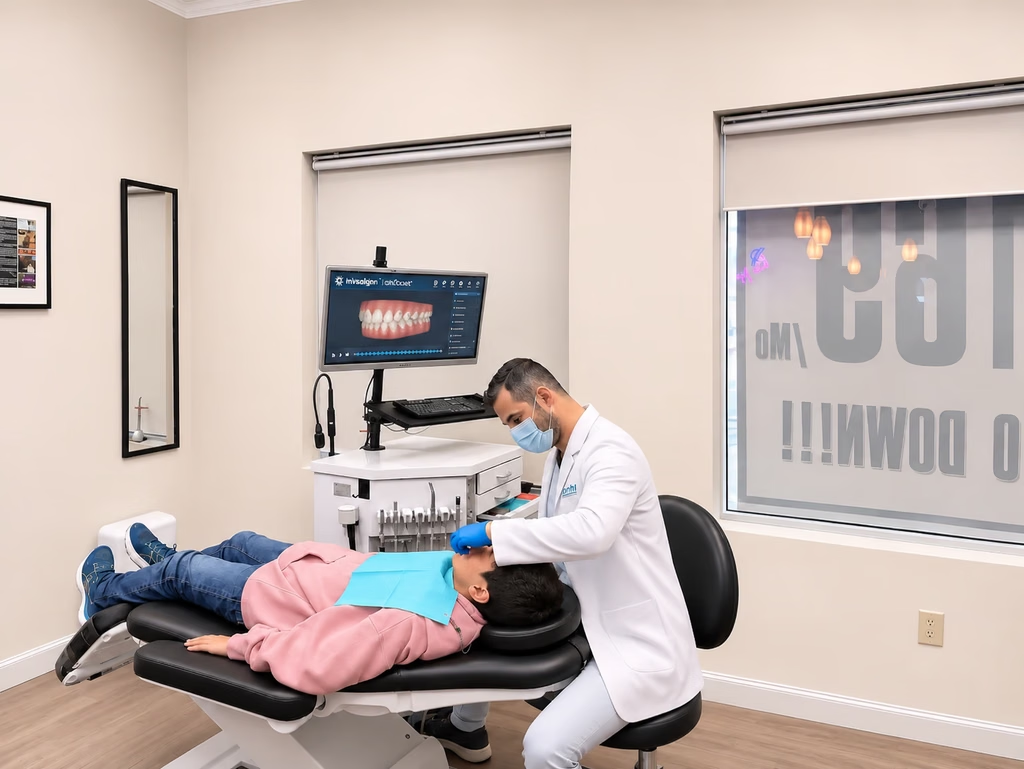
A preview of the movement. We use digital treatment planning to see the planned position of each tooth before treatment starts, so we can adjust the plan when needed.
Step four: the fee, without surprises
We do not think anyone should have to guess what treatment will cost. At the end of your consultation, our team explains your total treatment fee and your payment options. Your fee is based on the length of your treatment, and that is what you pay, with no unexpected treatment charges from our office.
On payment, we offer in-house financing with no credit check, as well as third-party financing through CareCredit and Cherry. We are in network with Delta Dental, Cigna, Aetna, MetLife, GEHA/Connection Dental, Boon-Chapman, Humana, UnitedHealthcare and United Concordia, including PPO, DMO and DHMO plans. Our Fees and Insurance page has the current details and our current special.
If you are bringing a 7-year-old
The AAO recommends that children have their first orthodontic check-up no later than age 7. Around that age, children have a mix of baby and permanent teeth, which lets an orthodontist spot developing problems early.
Most children will not need treatment at 7. More often, the consultation ends with “everything looks on track” or “let’s keep an eye on this.” Dr. Amini and Dr. Mansouri see the age 7 visit as a way to decide whether treatment, monitoring or simple observation is right. When a significant bite or jaw problem is present, treating during growth can give benefits that are harder to achieve later. Our Phase I and appliances page explains what early treatment can involve.
If you are an adult, or switching orthodontists
It is never too late. We treat adults of all ages, including patients in their 80s. For adults, your consultation pays extra attention to gum health, bone support, existing crowns or bridges, and how the jaws fit together. When additional dental care is needed, we coordinate with an established network of dentists and specialists. Dr. Amini and Dr. Mansouri believe age alone is not a reason to rule out treatment; healthy teeth, gums and bone are what matter.
If you are transferring from another office, bring what records you have. We will evaluate the plan in progress, including whether expansion matches the bite problem, whether any impacted teeth need surgical exposure, and how growth may affect the result.
After the consultation
You leave with a diagnosis, a plan, a timeline and a fee. When you are ready to move forward, the next step depends on your treatment. For aligners, we take scans and photos to finalize the plan, and your aligners typically arrive at our office about four weeks later. For braces, your team will tell you how soon your appointment can be scheduled. If you are a candidate for braces and would like to begin treatment, we may be able to start the same day as your consultation.
Once treatment begins, regular visits keep things on track. Our post on what happens during an orthodontic checkup explains those appointments.
Which office is closer to you?
Both offices offer the same consultation, led by board-certified orthodontists.
West Side San Antonio (9262 Culebra Rd., Suite 106) serves families from Culebra, Alamo Ranch, Great Northwest, the SeaWorld area, Helotes, the Far West Side and Northwest San Antonio. See our West Side San Antonio office page.
North-East San Antonio (7975 FM 78, Suite 1) serves families from Converse, Universal City, Live Oak, Windcrest, Kirby, Schertz and Cibolo. See our North-East San Antonio office page.
Questions patients ask about the orthodontic consultation
Is the consultation at Amini Orthodontics really free?
Yes. The consultation at Amini Orthodontics is complimentary, and it includes panoramic and cephalometric X-rays, digital scans and photographs. Patients transferring from another orthodontist also pay no consultation fee.
Will my child get braces at the first visit?
Not necessarily. The first visit is for diagnosis and planning, and many children seen around age 7 need only monitoring, not treatment. If your child is a candidate for braces and you would like to begin treatment, we may be able to start the same day. If treatment is recommended, the orthodontist will explain when it should start and why.
How long does treatment take after the consultation?
Most cases at Amini Orthodontics are treated in about 12 to 24 months, depending on how complex the case is. Your orthodontist gives you an estimated timeline at the consultation, based on your own records.
Do I need a referral from my dentist?
No referral is needed to book a consultation at Amini Orthodontics. You can call either office or request a visit online, and we are happy to share findings with your dentist.
Sources
- American Association of Orthodontists. “Consultation” FAQ. https://aaoinfo.org/faqs/consultation/
- American Association of Orthodontists. “What Happens at Your First Orthodontic Appointment? A Step-by-Step Guide.” https://aaoinfo.org/whats-trending/first-orthodontic-appointment/
- American Association of Orthodontists. “Child Orthodontics” FAQ (check-up by age 7). https://aaoinfo.org/faqs/child-orthodontics/page/4
- American Association of Orthodontists. “Problems to Watch for in Growing Children.” https://www.aaoinfo.org/wp-content/uploads/2018/09/PTWF_Grow_Child-17-hl.pdf


